The store will not work correctly when cookies are disabled.
We use cookies to make your experience better.To comply with the new e-Privacy directive, we need to ask for your consent to set the cookies. Learn more about our cookies policy.
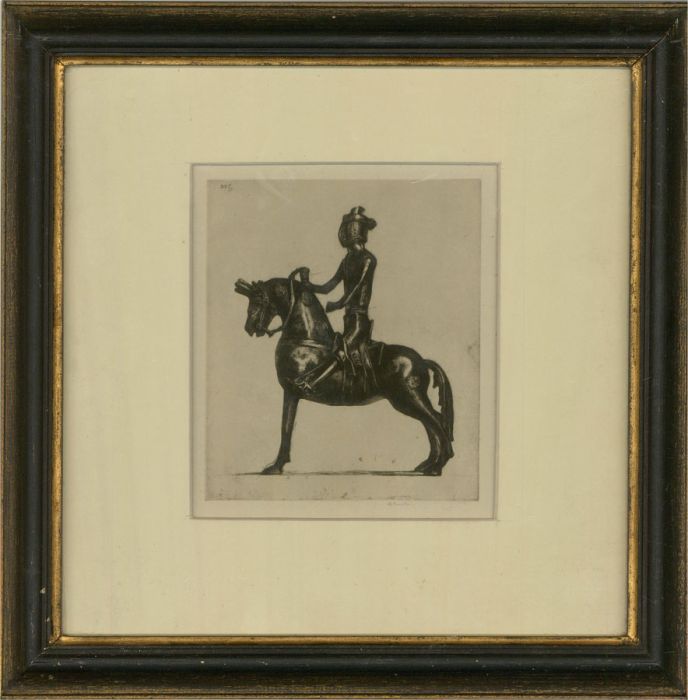
A dark and intriguing etching of a curious artifact. This aquamanile (elaborate brass ewer or jug) is in the form of a medieval knight on horseback. Based on a XIVth century brass acquired by Mr. R. M. Walker from the Randolph Berens collection, 1910, said to have come from Hereford Cathedral.
The artist has initialed in plate at the top left and signed in plate at the lower right. The etching has been presented in a black wax and gilt frame with card mount.
On wove.
Condition
The condition is typical for a picture of this age including some discolouration. The mount has some dirtying and discolouration.
Size
15 x 13cm (5.9" x 5.1")
Artist Biography
Cameron was the son of the Rev. Robert Cameron and was born in Glasgow, Scotland. He was educated at The Glasgow Academy. From around 1881 he studied at the Glasgow School of Art and in 1885 enrolled at the Edinburgh Schools of Art. Cameron became a skilled etcher making a name for himself in this medium and gaining international recognition by the 1890s. He was elected associate of the Royal Society of Painter-Etchers (RE) in 1889. In 1895 he was elected Fellow of the RE. He exhibited regularly from 1889 to 1902, before resigning his membership in 1903. His subjects included architectural studies, of which he produced a number of popular 'sets' and landscapes. He received various medals and awards for his etchings.
As well as becoming well known as an etcher the artist also produced a great many oil paintings and watercolour sketches of landscapes and architectural subjects. Cameron's earliest known oil painting dates to 1883.
In 1899 Cameron and his wife moved to Kippen in the Scottish Highlands. This was near to Stirling with views of Ben Lomond and across to Stirling Castle. In 1901 Cameron became a member of the anti-Royal Academy society the International Society of Sculptors, Painters and Gravers, (later The International) that had been founded by Whistler in 1898. He exhibited with the society from 1898 and later served on its council. Following his resignation from the RE, Cameron and 11 other artists formed The Society of Twelve in 1904 with the objective to promote the original print. He became a member of the Royal Society of Painters in Watercolours in 1906. He was elected Associate of the Royal Scottish Academy (RsA) in 1904 (on his 6th attempt) and became RsA in 1918. Having previously been elected Associate of the Royal Academy (ARA) in the engraver class in 1911, in 1916 he was also elected ARA for his painting. He was elected a full Royal Academician (RA) in 1920. During these years Cameron's work was also exhibited at the Royal Society of Oil Painters, the Royal Glasgow Institute, the Walker Art Gallery, Liverpool, as well as showing in overseas exhibitions.
Cameron was well known and liked in the art world and held a great many appointments to societies and boards. On the retirement of RsA president Sir James Guthrie in 1919, it was suggested that Cameron stand for the presidency. Cameron declined however, citing too many existing responsibilities in London. In 1917-18 Cameron was commissioned by the Canadian Government to paint the war in France. Cameron was knighted in 1924 and was a Trustee of the Tate Gallery from 1921 to 1927 and the Scottish National Gallery, and was the King's Painter and Limner in Scotland 1933. Cameron died in Perth, Scotland on 16 September 1945.