Description
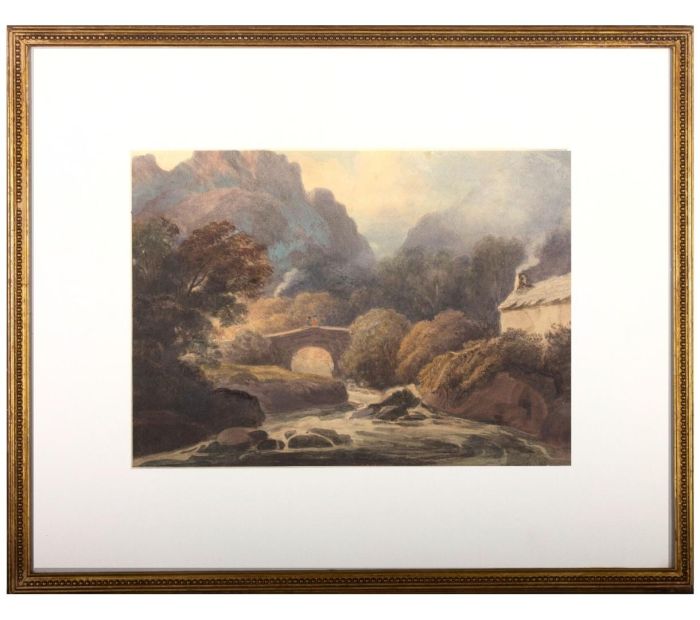
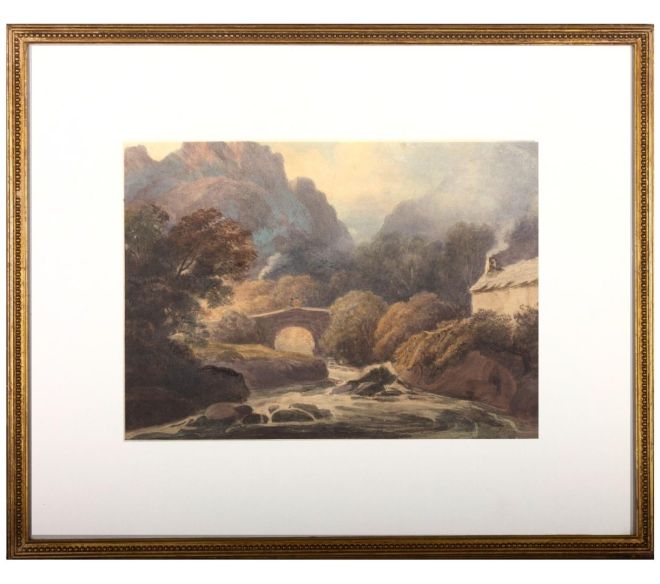
A very fine watercolour by the esteemed painter and astrologer John Varley (1778-1842). The painting depicts two figures stood on a historic packhorse bridge crossing a river in the mountains. Smoke flows from the chimney of a cottage situated to the right of the composition. Presented glazed in a white mount and a 19th-century gilt frame with beaded detailing. Signed to the lower-right edge. On wove.
Condition
The condition is typical for a picture of this age including some mild discolouration. There is a faint crease to the upper-right corner and a closed tear to the upper-right edge with a minor loss. There are some mild chips to the frame, primarily at the corners, and a couple of losses to the beading. Overall well-presented and in good condition.
Size
27.8 x 37.9cm (10.9" x 14.9")Framed Size: 49.6 x 60.3cm (19.5" x 23.7")
Artist Biography
John Varley (1778-1842) was an English watercolour painter and astrologer, and a close friend of William Blake (1757-1827). They collaborated in 1819-1820 on the book 'Visionary Heads', written by Varley and illustrated by Blake. He was the elder brother of a family of artists: Cornelius Varley, William Fleetwood Varley, and Elizabeth, who married the painter William Mulready. John Varley was born at the Old Blue Post Tavern, Hackney, on 17 August 1778. His father, Richard Varley, born at Epworth in Lincolnshire, had settled in London after the death of his first wife in Yorkshire. His parents discouraged his leanings towards art and placed him under a silversmith.
On the death of his parents, Varley was for a brief time employed by a portrait painter in Holborn and then, at the age of 15 or 16, he became a pupil of Joseph Charles Barrow (fl. 1789-1802) who had an evening drawing school twice a week at 12 Furnival's Inn Court, Holborn. It was Barrow who took Varley on a sketching tour to Peterborough from which he emerged as a professional painter. In 1798 he exhibited a highly regarded sketch of Peterborough Cathedral at the Royal Academy and became a regular exhibitor at the RA until the foundation of the Old Watercolour Society in 1805.
In 1799 he visited North Wales, and in its wild mountain scenery found the subjects best suited to his brush. He returned to the same district in 1800, and again in 1802, and the impressions then received powerfully influenced the whole course of his art. As one of the founders of the OWS, Varley exhibited largely there over 700 drawings. He also became a highly successful drawing master with pupils including Copley Fielding, David Cox, John Linnell and William Turner of Oxford. Despite his success, his growing family meant he was constantly in financial difficulties, 'since he was both a hopeless businessman and by temperament something of a Micawber'. (Mallalieu). Varley was particularly skilled at the laying of flat washes of watercolour which suited the placid, contemplative mood that he often sought to evoke.
Varley published 'A Treatise on the Principles of Landscape Drawing', 1816-21 and 'A Practical Treatise on the Art of Drawing in Perspective'. He also wrote an astrological text (with illustrations) entitled 'A Treatise on Zodiacal Physiognomy' in 1828. He is buried at Kensal Green Cemetery.