The store will not work correctly when cookies are disabled.
We use cookies to make your experience better.To comply with the new e-Privacy directive, we need to ask for your consent to set the cookies. Learn more about our cookies policy.
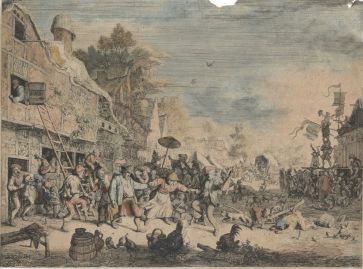
Cornelis Dusart - Original 1685 Etching. Hand coloured. Signed and dated in the plate. On watermarked laid. Losses at upper edge and top right. Narrow margins.cornelis dusart (1660–1704, Haarlem) The Grand Village Festival. Etching 1685. The painter Cornelis Dusart produced about 15 etchings and a fairly large number of mezzotint prints, some of which were produced in collaboration with his friend and fellow-artist Jacob Gole. Dusart, who worked his whole life in Haarlem, was apprenticed to Adriaen van Ostade in 1675 and admitted, as a free master, to the Guild of St. Luke in Haarlem in January 1679. His extensive oeuvre of paintings and drawings marks the final high point of the peasant genre in Dutch art. The artist’s style was greatly influenced by his master Ostade; after his death Dusart acquired the contents of his studio, including a substantial stock of partly unfinished paintings, drawings and prints. Another major source of creative inspiration was Jan Steen’s genre painting with its moralistic and satirical undertones. Right from his childhood days Dusart suffered from poor health and, having remained a bachelor all his life, died in Haarlem in 1704. The Grand Village Festival is generally regarded as Dusart’s printmaking masterpiece. Gathered on the village square, a crowd of people are in the throes of a wild and boisterous celebration. The peasants are drinking and dancing as if in a frenzy, urged on by the music of a violinist stood on a stool in front of the village inn. The banner with the inscription “Gulde Schenk Kan” (The Golden Jug), which flutters fitfully in the breeze, is a hidden reference to the root of all evil: the excessive alcoholism of country folk. With a fastidiousness reminiscent of his great predecessor, Pieter Brueghel the Elder, Dusart has depicted the whole repertoire of human folly in an expressive and humorous vein. In the middle ground a quack doctor is prizing his dubious services while, on a platform to the right, acrobats are performing daring feats in front of a group of spectators. Only the animals have evidently not lost their senses. Seemingly untroubled by the noisy spectacle around them, the pigs and chickens run around unhindered in their search for food.