The store will not work correctly when cookies are disabled.
We use cookies to make your experience better.To comply with the new e-Privacy directive, we need to ask for your consent to set the cookies. Learn more about our cookies policy.
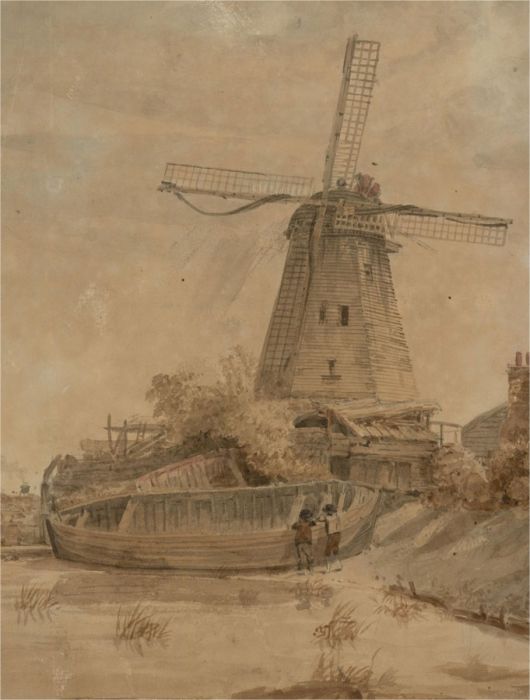
A view of a historic mill with two boys leaning on a beached boat in the foreground. Unsigned. The attribution is inscribed on the verso. On wove.
Condition
There is some discolouration and some marks and creases to the substrate. There are some creases to the corners and a small tear to the lower-left corner.
Size
24.3 x 18.4cm (9.6" x 7.2")Sheet: 26.5 x 21.5cm (10.4" x 8.5")
Artist Biography
Sir Richard Westmacott RA (1775-1856) was a British painter and sculptor. Westmacott studied with his father, also named Richard Westmacott before going to Rome in 1793 to study under Antonio Canova. Westmacott devoted all his energies to the study of classical sculpture, and throughout his life his real sympathies were with pagan rather than with Christian art. Within a year of his arrival in Rome he won the first prize for sculpture offered by the Florentine Academy of Arts, and in the following year he gained the papal gold medal awarded by the Academy of St Luke with his bas-relief of Joseph and his brothers. On returning to England in 1797, he set up a studio, where John Edward Carew and Musgrave Watson gained experience. Westmacott had his own foundry at Pimlico, in London, where he cast both his own works and those of other sculptors, including John Flaxman's statue of Sir John Moore for Glasgow. Late in life he was asked by the Office of Works for advice on the casting of the reliefs for Nelson’s Column. He also had an arrangement with the Trustees of the British Museum, which allowed him to make moulds and supply plaster casts of classical sculpture in the museum's collection to country house owners, academies and other institutions.
He exhibited at the Royal Academy between 1797 and 1839. He was elected an associate of the Royal Academy in 1805 and a full academician in 1811. His academy diploma piece, a marble relief of Jupiter and Ganymede, is still in the academy's collection. He was a professor of sculpture at the academy from 1827 until his death. He received his knighthood on 19 July 1837. Among his works are the reliefs for the north side of Marble Arch, the sculptures of figures representing The Progress of Civilisation on the pediment of the British Museum, and the Waterloo Vase now in Buckingham Palace Gardens. This enormous urn was sculpted from chunks of marble earmarked by Napoleon for a trophy commemorating his anticipated victory in the Napoleonic Wars and then given to George IV as a gift from the Grand Duke of Tuscany. His statue of Horatio Nelson, Birmingham, was the first statue of Nelson in Britain. Westmacott also sculpted the memorials to William Pitt the Younger, Spencer Perceval, Charles James Fox and Joseph Addison in Westminster Abbey; the statue of Fox in Bloomsbury Square; and those to Sir Ralph Abercromby, Lord Collingwood and Generals Pakenham and Gibbs in St Paul's Cathedral.