The store will not work correctly when cookies are disabled.
We use cookies to make your experience better.To comply with the new e-Privacy directive, we need to ask for your consent to set the cookies. Learn more about our cookies policy.
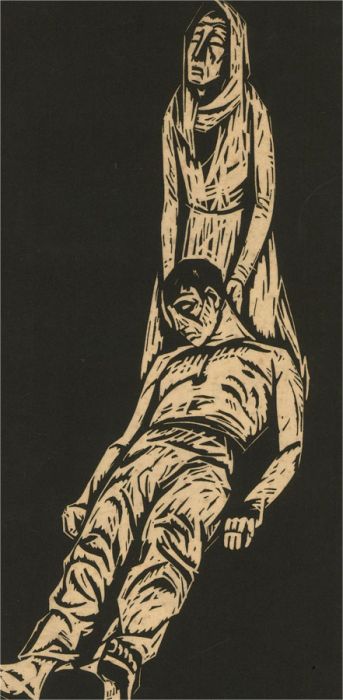
A heavy hitting and graphic woodcut by the Galician-Jewish illustrator and painter, Arthur Kolnik. The woodcut shows a poor woman, looking despairingly up at the sky as she cradles the head of a man lying dead before her. Contextualized by his persecution for his people's religion in the second World War, this piece takes on a much darker tone, filled with the true horror of human suffering.
The artist has signed to the lower right and inscribed and numbered (no.24) to the lower edge.
On thin pulp paper.
Condition
The condition is typical for a picture of this age including some discolouration and light foxing across the surface.
Size
36 x 18cm (14.2" x 7.1")
Artist Biography
Arthur Kolnik (born May 4, 1890 in Stanisławów , Austria-Hungary , today Ivano-Frankiwsk, 1972 in Paris ), was a Galician-Jewish illustrator and painter. According to Nadine Nieszawer, it is assigned to the modern first École de Paris. His paintings and expressionist woodcuts show the figures and images of Eastern European Judaism , the world of the shtetl that was extinguished by the Holocaust . Arthur Kolnik was the child of a Lithuanian father and a Viennese mother. After attending the school in Stanisławów, he studied at the Academy of Fine Arts in Cracow from 1908 to 1914 . He took part in the First World War as an officer in the Austro-Hungarian Army and was wounded in a Vienna hospital in 1916. There he met the painter Isidor Kaufmann that was important for him.
In 1918 Kolnik moved to Chernivtsi. In November 1918 he took part in an art exhibition in the Czernowitz Trade Museum. In 1920 and 1921 he stayed in New York together with the painter Reuven Rubin , who was also friends. Both exhibited together in the Anderson Galleries by Alfred Stieglitzout. In 1921, again in Chernivtsi, Kolnik illustrated a Yiddish school book by Elieser Steinbarg and exhibited it in 1922 at the Chernivtsi Art Association. Another exhibition followed in 1926 and in 1928 a portfolio with woodcuts containing the fables of Elieser Steinbargs. In 1929 he created a portrait of Itzig Manger, which he executed in various versions, including a drawing. Kolnik spent the rest of his life in Paris. In 1931 he settled there with his first wife and two children. He then worked as a cartoonist and for fashion magazines, creating woodcuts in his free time. Woodcuts were printed in Paris in 1933 and 1934. In 1935 Kolnik exhibited in Buenos Aires and in 1936 an edition of Steinbarg's Fables with 109 woodcuts by Kolnik appeared in Chernivtsi. In 1938 Kolnik worked for the Franco-German magazine Verbe - Cahiers Humains. From 1940 to 1944 Kolnik and his family were interned in a camp for stateless persons. After the end of the Second World War he was able to publish illustrations again in 1946, 1948 and 1949. In 1948 he took French citizenship. He became a member of the Association of Jewish Painters and Sculptors in France and received the Prix Chaban in New York in 1952 . In 1962 his first wife died. He later married again, his second wife was the painter Ezra Kolnik. Kolnik died in Paris in 1972.