Description
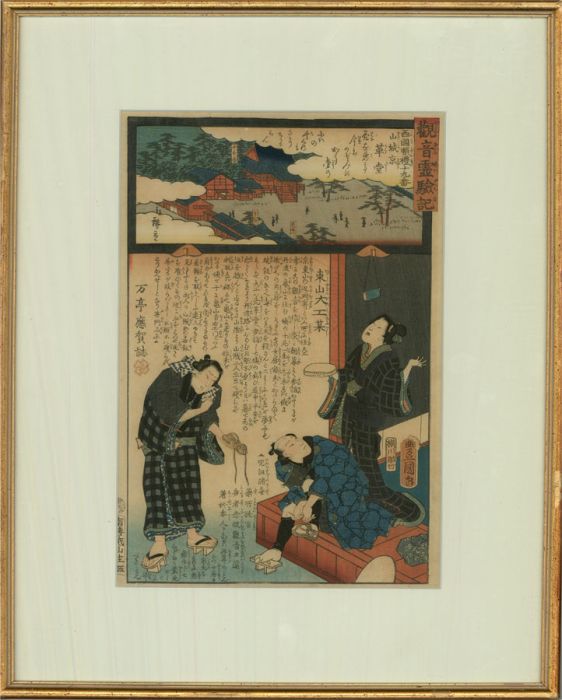
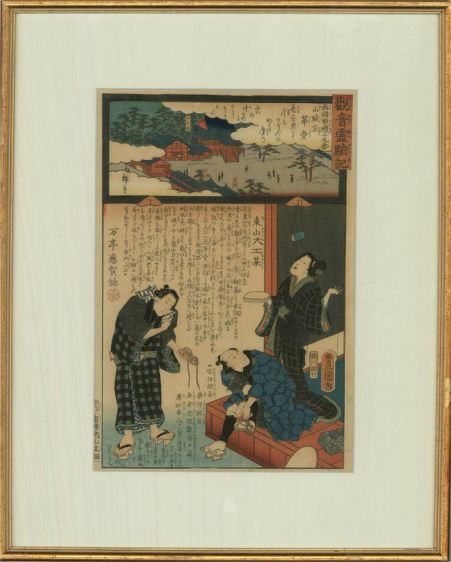
A fine 19th century woodblock print by the well listed Japanese artist Utagawa Kunisada, a prolific and commercially successful designer of ukiyo-e woodblock prints. The scene shows a traditional interiors, with two men preparing to leave the home, putting on their shoes, as the woman of the house looks up at the cricket box above her head (cricket boxes were often hun in doorways for good luck on departures and long journeys. If the cricket was dead when someone departed, that was a bad omen). She has a shocked look on her face and seems to be carrying a bento box, perhaps to give to one of the departing men. The artist has signed in characters inside his traditional toshidama cartouche to the lower right. The whole scene is inscribed with a complex plot in kanji.
The woodblock has been presented in a simple gilt frame with card mount.
On pith paper.
Condition
The condition is typical for a picture of this age including some discolouration. Some scratching to the frame at the right edge.
Size
33.2 x 21cm (13.1" x 8.3")Framed Size: 51.7 x 41.3cm (20.4" x 16.3")
Artist Biography
Utagawa Kunisada (1786 – 12 January 1865), also known as Utagawa Toyokuni III (Sandai Utagawa Toyokuni), was the most popular, prolific and commercially successful designer of ukiyo-e woodblock prints in 19th-century Japan. In his own time, his reputation far exceeded that of his contemporaries, Hokusai, Hiroshige and Kuniyoshi.At the end of the Edo period (1603–1867), Hiroshige, Kuniyoshi and Kunisada were the three best representatives of the Japanese color woodcut in Edo (capital city of Japan, now Tokyo). However, among European and American collectors of Japanese prints, beginning in the late 19th and early 20th century, all three of these artists were actually regarded as rather inferior to the greats of classical ukiyo-e, and therefore as having contributed considerably to the downfall of their art. For this reason, some referred to their works as "decadent".
Beginning in the 1930s and 1970s, respectively, the works of Hiroshige and Kuniyoshi were submitted to a re-evaluation, and these two are now counted among the masters of their art. Thus, from Kunisada alone was withheld, for a long time, the acknowledgment which is due to him. With a few exceptions, such as actor portraits (yakusha-e) and portraits of beautiful women (bijin-ga), at the beginning of his career, and some series of large-size actor head-portraits near the end, it was thought that he had produced only inferior works. It was not until the early 1990s, with the appearance of Jan van Doesburg's overview of the artistic development of Kunisada, and Sebastian Izzard's extensive study of his work, that this picture began to change, with Kunisada more clearly revealed as one of the "giants" of the Japanese print that he was.