Description
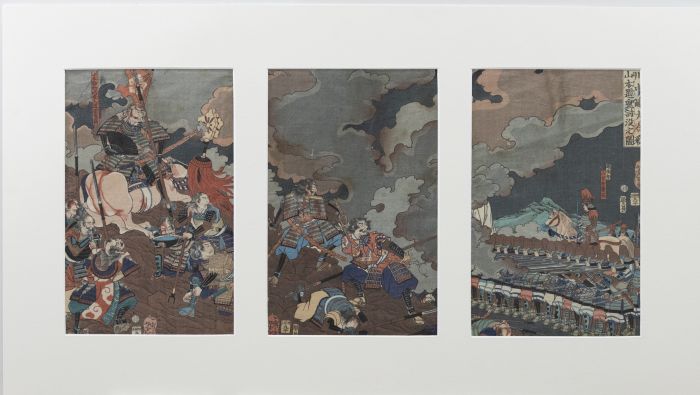
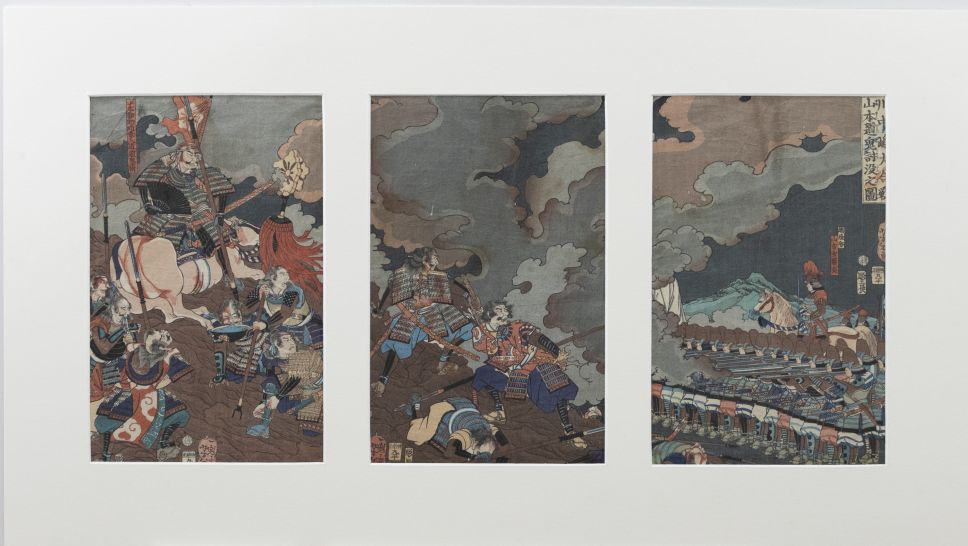
An extraordinary ukiyo-e triptych by one of the greatest ukiyo-e artists of the 19thC, Tsukioka Yoshitoshi (1839-1892). The triptych shows a dramatic scene from the epic, bloody fourth battle of the Kawanakajima war. Of all of the triptychs Yoshitoshi made illustrating these battles, this particular one is the most illusive in today's market. The colour of the gourd that holds Yoshitoshi's signature indicate that this is an early strike, likely from the original year of printing in 1866.
The scene shows Yamamoto Kansuke (on horseback to the left, holding a military signalling fan) and the remnant of his troops on a hillock mown down by the Uesugi musketeers at Kawanakajima. Shortly after this, Kansuke, believing his tactic had failed, retired to the top of the hill and committed suicide.
The brutal detail in this triptych is a classic trait in this era of ukiyo-e; the soldiers faces covered with blood, stumbling away from the gun fire with shoes falling off,tying bandages and drinking water in a desperate attempt to heal their wounds. The swirling smoke and chaotic movement create an incredibly tense, dynamic war scene that is indicative of the skill and vision Yoshitoshi possessed.
Each panel has been finished with the artist's signature (shown in a red gourd). The kanji to the left read with the name of General Kansuke and the kanji to the right panel likely read with a brief summation of the scene. The triptych has been presented in a crisp, triple window mount. There is a handwritten note with brief information about the print.
On pith paper.
Condition
The condition is typical for a picture of this age including some discolouration. There is light creasing across the surface with slightly heavier creasing at the upper left corner, however this does not affect the integrity of the image. There are small holes running down one side of each print, likely from having been previously bound in a book. The mount is in fine condition.
Size
33 x 72cm (13" x 28.3")Framed Size: 49 x 88cm (19.3" x 34.6")
Collection Information
The Battles of Kawanakajima were a series of battles fought in the Sengoku period of Japan between Takeda Shingen of Kai Province and Uesugi Kenshin of Echigo Province from 1553 to 1564.
Shingen and Kenshin contested each other for control of the plain of Kawanakajima between the Sai River and Chikuma River in northern Shinano Province, located in the present-day city of Nagano. The battles were triggered after Shingen conquered Shinano, expelling Ogasawara Nagatoki and Murakami Yoshikiyo, who subsequently turned to Kenshin for help. Five major battles of Kawanakajima occurred: Fuse in 1553, Saigawa in 1555, Uenohara in 1557, Hachimanbara in 1561, and Shiozaki in 1564.[4] The most famous and severe battle was fought on 18 October 1561 in the heart of the Kawanakajima plain, thus being known the Battle of Kawanakajima The battles were ultimately inconclusive and neither Shingen or Kenshin established their control over the plain of Kawanakajima.
The Battles of Kawanakajima became one of "the most cherished tales in Japanese military history", the epitome of Japanese chivalry and romance, mentioned in epic literature, woodblock printing, and movies.
See More Like This
For our full collection of Tsukioka Yoshitoshi (1839-1892) artworks click here
Artist Biography
Tsukioka Yoshitoshi (Japanese: 月岡 芳年; also named Taiso Yoshitoshi 大蘇 芳年; 30 April 1839 – 9 June 1892) was a Japanese printmaker.
Yoshitoshi has widely been recognized as the last great master of the ukiyo-e genre of woodblock printing and painting. He is also regarded as one of the form's greatest innovators. His career spanned two eras – the last years of Edo period Japan, and the first years of modern Japan following the Meiji Restoration. Like many Japanese, Yoshitoshi was interested in new things from the rest of the world, but over time he became increasingly concerned with the loss of many aspects of traditional Japanese culture, among them traditional woodblock printing.
By the end of his career, Yoshitoshi was in an almost single-handed struggle against time and technology. As he worked on in the old manner, Japan was adopting Western mass reproduction methods like photography and lithography. Nonetheless, in a Japan that was turning away from its own past, he almost highhandedly managed to push the traditional Japanese woodblock print to a new level, before it effectively died with him.
His reputation has only continued to grow, both in the West, and among younger Japanese, and he is now almost universally recognized as the greatest Japanese artist of his era.