Description
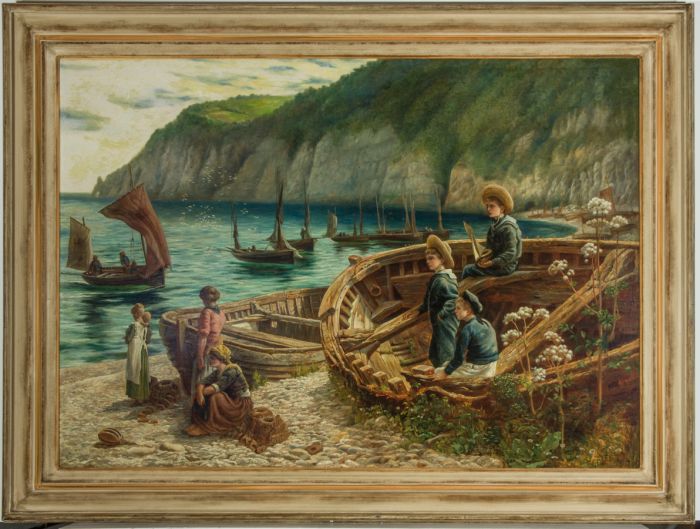
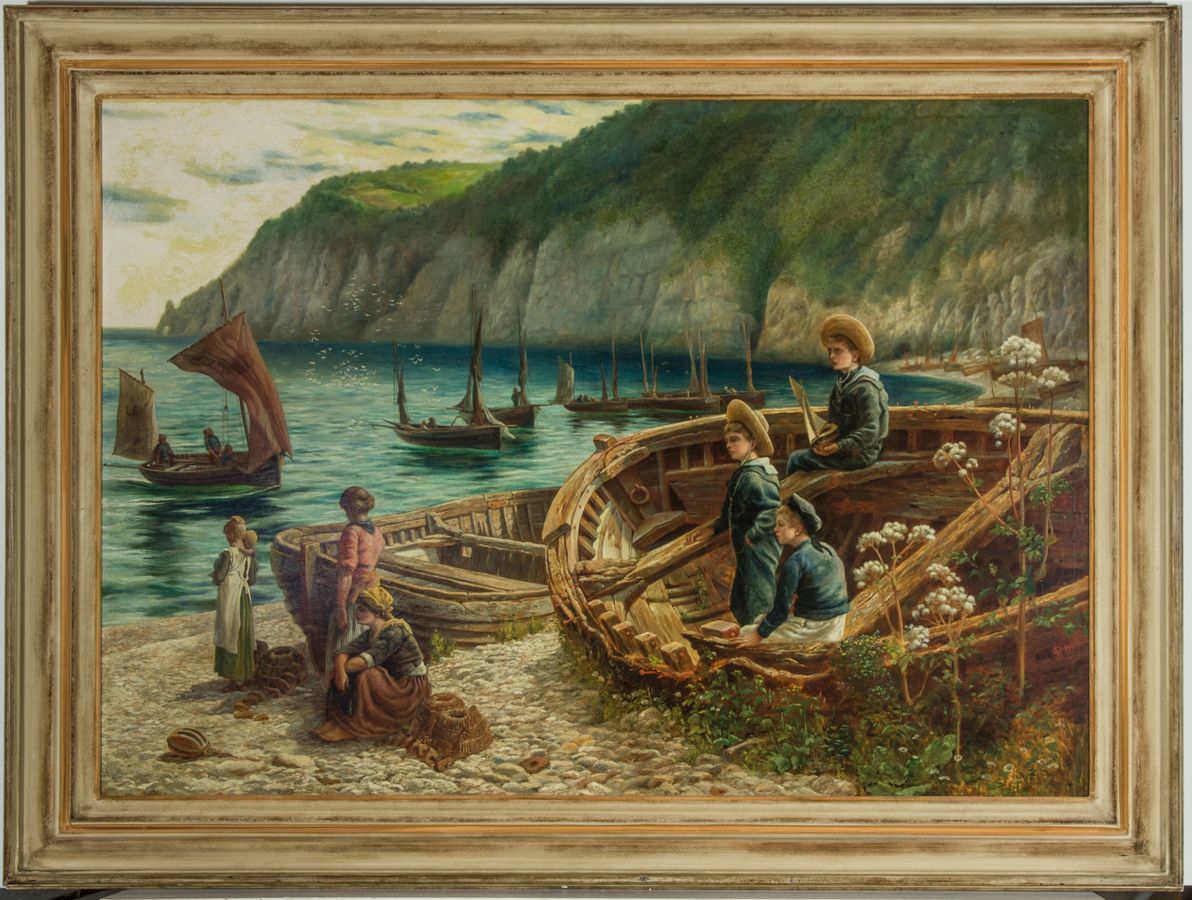
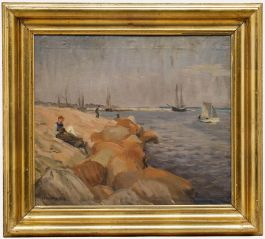
We are pleased to present this stunning Pre-Raphaelite style oil painting of a Devon coastal scene, depicting figures at Beer Head looking West, surrounded by the distinctive Beer beach boats.
This striking coastal scene depicts children from the Beer fishing community awaiting the return of fisherman. They patiently wait on a rocky beach shore surrounded by imposing cliffs. The beach is scattered with the skeletons of old Beer beach boats, symbolising the seafaring history of the area, and the fishing industry that lies at the heart of its community. The flock of gulls following the boats into shore celebrates a successful day at sea.
The children have been portrayed in the recognisably realist style of the Pre-Raphaelites, who sought to paint serious subjects in high realism, inspired to paint in nature by the writer John Ruskin - the present painting is a stunning example of this. The three brothers stare wistfully into the distance from their wrecked boat, and this composition symbolises a glimpse into their tough future at sea alongside their fathers. The four sisters take on the role of fishermen's wives, and stare out to sea, anxiously awaiting the safe return of the fishermen. One holds a tiny baby in her arms, bringing home how dependent families were on the sea's bounty.
The painting bears a monogram and date in red to the lower right. Monograms (particularly painted in red) were a common demarcation of the Pre-Raphaelite Brotherhood, the most famous of which belongs to Dante Gabriel Rossetti. We have found very similar monograms as the one found on the present painting belonging to Charles E. Robertson ARWS ( (1844-1891), also known as Charles Robertson II. An excellent example of his monogram can be found in his oil painting 'Moschea', sold at auction in Genoa for £15,000 in 2016. Robertson was best known for his Oriental paintings.
There is also a very similar monogram listed in Peter Nahum's 'Victorian Painters Monograms' under Robert Walker Macbeth RA ARWS (1849-1910), a Scottish painter and etcher. Macbeth painted genre and pastoral scenes, inspired by the great Pre-Raphaelite follower Frederick Walker (1840–1875).
The painting is beautifully presented in an attractive modern pale wood frame with gilt detailing.
On canvas on stretchers.
Condition
Overall the appearance is excellent. The colours are crisp and clear. The painting has been cleaned, lined and likely re-varnished. Areas of mild craquelure have been stabilised and the paint layer is stable and sound. There are remnants of old varnish to sky, some of which has yellowed as shown in the photos. The frame is in very good condition.
Size
69 x 98cm (27.2" x 38.6")Framed Size: 88 x 117cm (34.6" x 46.1")
Collection Information
Pre-Raphaelites in Cornwall
The present painting draws comparisons with the work of the Newlyn School group of artists. The late nineteenth century saw the flourishing of the so-called ‘Newlyn School’, a colony of realist painters based in the village of Newlyn near Penzance. Virginia Woolf summered in Cornwall as a child in the 1880s and ’90s, and her first truly experimental novel, Jacob’s Room (1922), opens with impressionistic descriptions of the Cornish seaside; not to mention To the Lighthouse (1927), informed by childhood memories of St Ives. In the 20th century, most famously, the county attracted and inspired a large circle of modernist painters, sculptors and writers – among them Barbara Hepworth, Ben and Winifred Nicholson, Patrick Heron, Sven Berlin and Christopher Wood – who decamped from London to settle in St Ives. The Tate opened an outpost museum there in 1993, and also maintain the Barbara Hepworth Museum in St Ives, as a result of the town’s prominent role in the development of modern British art.
In September 1860 Holman Hunt and Valentine Cameron Prinsep travelled from London down to Penzance. They took the boat over to the Scilly Isles to join Alfred Lord Tennyson, Francis Turner Palgrave and Thomas Woolner, who were beginning a walking tour of Cornwall.
Hunt supplies evocative descriptions of the group as they roamed the Cornish coast: ‘Tennyson in his slouch hat, his rusty black suit, and his clinging coat, wandering away among the rocks, assiduously attended by [Palgrave], and if by chance the poet escaped his eyes for a minute, the voice of Palgrave was heard above the sea and the wind calling “Tennyson, Tennyson”.’ Hunt recounts a conversation regarding Tennyson’s paranoia about his celebrity status – the poet feared that mobs of admirers lurked to accost him at every turn, and asked his companions not to say his name out loud in hotels and other public places – and tells of how the party journeyed to Helston, with Tennyson travelling in a dog-cart because of an injured foot. They also spent three days at Falmouth, where they chanced to meet Julia and Hester Sterling, the nieces of the Reverend F. D. Maurice, the Christian Socialist minister who was depicted in Ford Madox Brown’s Work (1852-63). Most of the time, however, Hunt and Prinsep sat on the cliffs and sketched and painted. Asparagus Island, located in Kynance Cove on the Lizard Peninsula, was the subject of a gloriously detailed and luminous watercolour by Hunt.
The above text is taken from the article Pre-Raphaelites in Cornwall by Robert Wilkes, featured on his blog 'Pre-Raphaelite Reflections': https://dantisamor.wordpress.com/2016/06/11/pre-raphaelites-in-cornwall/
Location
Devon, England, United Kingdom