Description
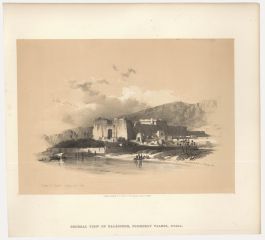
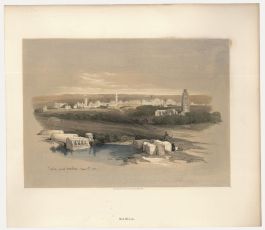
A chromolithograph of a view in the temple complex of Karnak near Luxor in Egypt by Louis Haghe (1806-1885) after a drawing by David Roberts RA RBA (1796-1864). Roberts set sail for Egypt on 31 August 1838. His intent was to produce drawings that he could later use as the basis for the paintings and lithographs to sell to the public. Egypt was much in vogue at this time, and travellers, collectors and lovers of antiquities were keen to buy works inspired by the East or depicting the great monuments of ancient Egypt. On his return to Britain, Roberts worked with Louis Haghe from 1842 to 1849 to produce the lavishly illustrated plates of 'The Holy Land, Syria, Idumea, Arabia, Egypt, and Nubia', originally published as 'Sketches in the Holy Land and Syria, 1842-1849' and 'Egypt and Nubia' series. Inscribed in plate with the location, date of the original drawing and date of the lithograph in plate to the lower-left edge and centre of the lower edge respectively, and inscribed with the names of the artists to the lower-right edge. On thick wove.
Condition
Cropped within the plate lines. There is some discolouration to the sky and some wear to the edges. Overall in good condition.
Size
39.2 x 30.8cm (15.4" x 12.1")Sheet: 43.1 x 33.8cm (17" x 13.3")
Artist Biography
Louis Haghe (1806 -1885) was a Belgian lithographer and watercolourist. His father and grandfather had practised as architects. Training in his teens in watercolour painting, he found work in the relatively new art of lithography when the first press was set up in Tournai. He visited England to find work, and settled there permanently in 1823. Together with William Day (1797-1845), around 1830 he formed the partnership Day and Haghe, which became the most famous early Victorian firm of lithographic printing in London.
Day and Haghe created and printed lithographs dealing with a wide range of subjects, such as hunting scenes, architecture, topographical views, and genre depictions. They pioneered the new techniques for chromolithography as well as hand-tinted lithographs. After William's death in 1845, the firm became known as 'Day and Son'. They were pioneers in developing the medium of the lithograph printed in colours.
In 1838, Day and Haghe were appointed 'Lithographers to the Queen'. Possibly his most ambitious project was providing 250 images for David Roberts' 'The Holy Land, Syria, Idumea, Arabia, Egypt, and Nubia' printed between 1842-1849.
From the mid-1850s Haghe concentrated more on his watercolours, and gained a reputation for his architectural scenes of northern Europe, with his pictures bought and displayed by the Victoria and Albert Museum. He also painted in oils, which were exhibited at the British Institution. He became president of the New Society of Painters in Water Colours from 1873 to 1884.
Location
Luxor Governorate, Karnak, Luxor, Egypt