Description
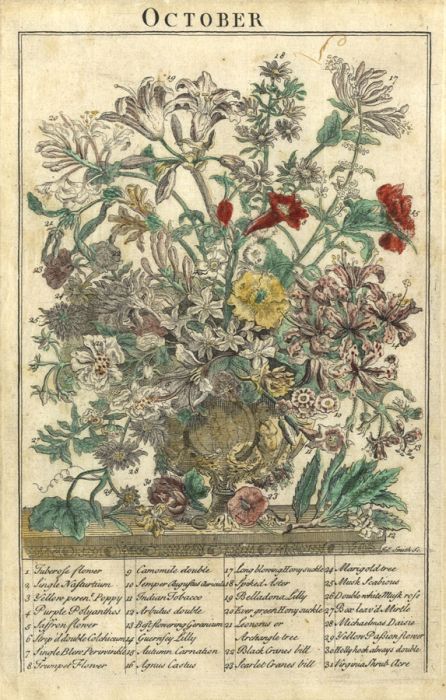
James Smith - Original 1732 Engraving. October from Flower Garden Displayed by Robert Furber. A wonderful hand coloured copper plate engraving. Published by Robert Furber as a catalogue for his nursery. The laid paper has quite an elaborate watermark. On watermarked laid. In fine condition.
Size
Size: 23.4 x 14.9cm (9.2" x 5.9")
Sheet: 25 x 16cm (9.8" x 6.3") Plate: 23.4 x 14.9cm (9.2" x 5.9")
Collection Information
Furber, Robert (c.1674–1756), nurseryman, established his Kensington nursery soon after 1700 near Hyde Park Gate and Kensington Gore, on the west of what became Gloucester Road. About 1706 he married Mary Everton; they had a son. Furber and Christopher Gray both bought some of the plants collected at Fulham Palace by Henry Compton, bishop of London, after the bishop's death in 1713, and by 1724 Furber's stock was rich enough for some of his exotic trees and shrubs, including the moss rose, to be listed by Philip Miller in his Gardeners and Florists Dictionary (1724). Furber was also one of the Society of Gardeners, led by Miller, which published the first part of its Catalogues plantarum in 1730, but by then he had issued two catalogues of his own, one of English and foreign trees, the other of ‘the Best and Choicest Fruit Trees’ (both in 1727). About 1720 Furber had published an engraving of a tulip tree, a magnolia (then considered another species of tulip tree), and a silk-cotton tree, all from the garden of Thomas Herbert, eighth earl of Pembroke; presumably the trees had been supplied by Furber, who prefaced his tree catalogue with a pleased account of his success in propagating the tulip tree, ‘notwithstanding some Writers have thought it difficult’. Furber's pictorial catalogues, collected as Twelve Months of Flowers, a dozen plates based on paintings by Peter Casteels, were issued plain or coloured; the main series was issued in 1730, with a thirteenth plate, containing subscribers' names within a border of flowers, following in 1732. So popular were these annotated flower-pieces, engraved by Henry Fletcher, that they were frequently copied at the time, and later reprints kept them in circulation. Smaller versions, engraved by James Smith, were used to illustrate The Flower-Garden Display'd (1732), with descriptions of the flowers probably written by Richard Bradley; and another set of small copies was issued by John Bowles in 1749 as Flora. A similar series of Twelve Plates with Figures of Fruit was published in 1732, again based on Casteels's paintings, illustrating fruit in season month by month. In 1733 Furber's Short Introduction to Gardening appeared, ‘Being several Useful Catalogues of Fruits and Flowers’ introduced to supplement the large plates and to help his customers ‘in furnishing their Gardens and their Tables’. The preface reminds its readers of the contents of Furber's nursery, as well as his own satisfaction with his work: Gardening is the Employment Providence has allotted me; and it happily falls out to be a Business the most suitable of all others to my Genius and Inclination. I have spent my Years in collecting, cultivating and improving all the different Kinds of Trees, Plants, Fruits, and Flowers, that I could possibly obtain; and in doing this, have spared neither Cost nor Pains. With intent to make the Love of Gardening more general, and the understanding of it more easy, I have from time to time published Catalogues, containing large Variety of Trees, Plants, Fruits, and Flowers, both Foreign and Domestic, cultivated by me for Sale. Furber was an overseer of the poor in the parish of St Mary Abbots, Kensington, in 1718, and a churchwarden in 1725–6 and 1736–7. He was buried at St Mary Abbots on 1 September 1756. He left his Kensington house to his wife and a legacy to their son, William, who had been apprenticed to Philip Miller in 1722. Most of his other property was left to John Williamson, who worked with Furber during his later years and who took over the Kensington nursery, which was maintained by a succession of gardeners until the late 1840s.