The store will not work correctly when cookies are disabled.
We use cookies to make your experience better.To comply with the new e-Privacy directive, we need to ask for your consent to set the cookies. Learn more about our cookies policy.
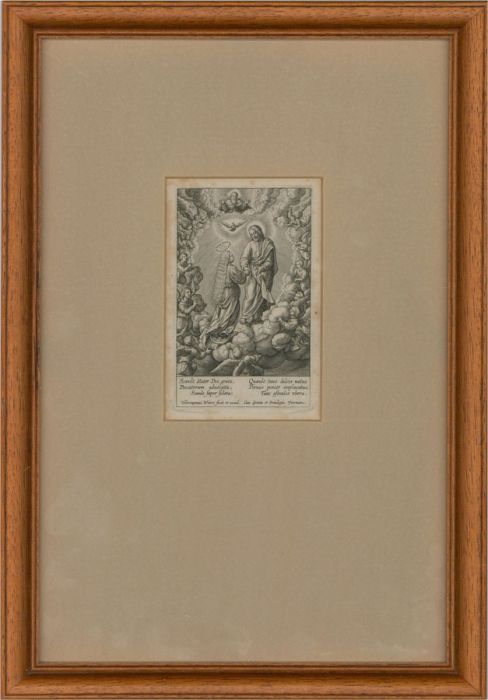
A fine 16th Century engraving showing Mary on the crescent moon, carried to heaven. Christ takes her hand and above him the Holy Spirit as a dove and God the Father, flies, surrounded by light. They are surrounded by angels in the clouds. There is an inscription in plate in Latin, roughly translating to "climb above the stars, welcome to God, avowed sinners, climb above the stars." The artist has inscribed their name in plate at the lower edge. The original plate lines are in tact. The engraving has been presented in a simple wood frame with card mount. On laid.
Condition
The condition is typical for a picture of this age including some discolouration and some foxing around the outer edges. The original plate lines are in tact.
Size
12 x 8cm (4.7" x 3.1")
Artist Biography
Hieronymus Wierix (1553–1619) was a Flemish engraver, draughtsman and publisher. He is known for his reproductive engravings after the work of well-known local and foreign artists including Albrecht Dürer. Together with other members of the Wierix family of engravers he played an important role in spreading appreciation for Netherlandish art abroad as well as in creating art that supported the Catholic cause in the Southern Netherlands. Hieronymus Wierix was born in Antwerp as the son of Anton Wierix I (c. 1520/25–c. 1572). His father Anton was registered as a painter in 1545–6 but is occasionally also referred to as a cabinet maker. It is not believed that Anton I taught Hieronymous or his other two sons Johannes and Anton II. Hieronymus and Johannes are believed to have trained with a goldsmith while Anton II likely trained with an older brother, probably Johannes. After his father death Hieronymus was placed under the guardianship of Sanson Catsopyn and Jheronimus Mannacker. His first engraving as independent master dates back to 1577. During the period of 1577–1580, he made a lot of prints for Willem van Haecht the Elder and Godevaard van Haecht. These works of him were mainly allegorical and political, where he reflected his sympathy for those who rebelled against the Spanish. Listed as Lutherans at the time of the Fall of Antwerp in 1585, the family members seem to have reconverted to Catholicism soon thereafter. The three Wierix brothers gained a reputation for their disorderly conduct as evidenced by a 1587 letter by prominent publisher Christophe Plantin to the Jesuit priest Ferdinand Ximenes in which he complained that whoever wanted to employ the Wierix brothers had to look for them in the taverns, pay their debts and fines and recover their tools, since they would have pawned them. Plantin also wrote that after having worked for a few days the brothers would return to the tavern. His apprentices were Abraham van Merlen, Jan Baptist van den Sande the elder, and Jacob de Weert. His daughter Christina married the engraver Jan Baptist Barbé, who later had his other daughter Cecilia (his sister-in-law) declared insane in order to claim her inheritance, which included a set of Dürer drawings.