The store will not work correctly when cookies are disabled.
We use cookies to make your experience better.To comply with the new e-Privacy directive, we need to ask for your consent to set the cookies. Learn more about our cookies policy.
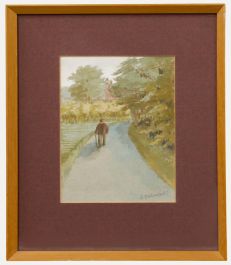
Harry Barr - Original 1966 Watercolour. Watercolour with distinctive scratching out. Signed and dated and inscribed. In fine condition.Harry Barr (1896-1987) studied at the Westminster School of Art where he was taught by the artist Walter Sickert and earned his diploma in 1915. Sickert remained an artistic mentor and a friend until he died in 1942. Barr was also good friends from childhood with David Bomberg until Bomberg's death in 1957. Harry Barr's first London exhibition was held in a Bloomsbury gallery in January 1920. Later in that year he moved to Paris. In Paris he befriended the sculptor Ossip Zadkine, who helped him find a studio. He had his first exhibition of oil paintings in Paris at the Galerie Mouninou on the Rue Marbeuf. Watercolour became Barr's main medium around 1939. He focused on painting nature. Among his most frequent subjects were trees that took on an anthropomorphic character. He painted all manner of landscapes and seascapes. His often pastoral scenes have been described as having "an economy of tone and statement that is positively Japanese". Barr had various exhibitions in London, one at the Kaplan gallery in 1965. This exhibition caught the attention of art critic Max Wykes-Joyce, whose write-up in the Arts Review stated that Harry Barr's "work can be compared with the best of British watercolourists, past or present". In the same year an exhibition of 60 paintings was held at Friendship House in Moscow. This was recorded as the first one-man show of a British artist in the USSR. The exhibition was well received and was extended from an original two to six weeks, showing also in Leningrad and Minsk. Other exhibitions in London included those at the October Gallery and posthumously at the Catto Gallery in 1990. Though likened to Philip Wilson Steer, the British impressionist, Harry Barr resisted pressure to join any of the English art movements. Barr's most distinctive works are characterised by the use of a knife to score the paper before painting. He described this technique in an interview published in the Daily Mail, explaining it as "an act of creation, and creation is not polite and hesitant".