Description
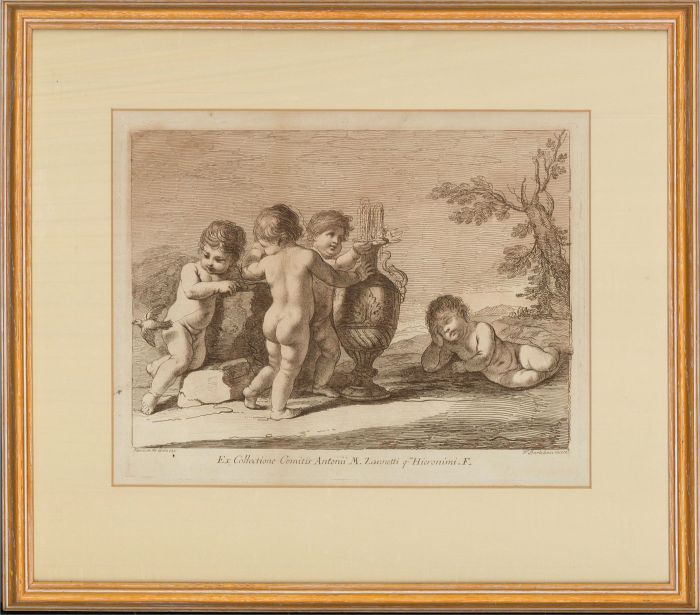
A fine engraving in sepia tones, showing four boys gathered round a water fountain, with one resting on the ground to the right. The artist has signed in plate to the lower edge and there is an inscription in Latin along the lower edge. The original plate lines are in tact. The engraving is after the original artwork by
Giovanni Francesco Barbieri. The engraving is presented in a simple lime washed wood frame with card mount. On wove.
Condition
In fine condition.
Size
22 x 31cm (8.7" x 12.2")
Collection Information
Giovanni Francesco Barbieri (February 8, 1591 – December 22, 1666), better known as Guercino, was an Italian Baroque painter and draftsman from Cento in the Emilia region, who was active in Rome and Bologna. The vigorous naturalism of his early manner contrasts with the classical equilibrium of his later works. His many drawings are noted for their luminosity and lively style.
See More Like This
For our full collection of Francesco Bartolozzi RA (1727–1815) artworks click here
Artist Biography
Francesco Bartolozzi RA (21 September 1727, in Florence – 7 March 1815, in Lisbon) was an Italian engraver, whose most productive period was spent in London. He is noted for popularizing the "crayon" method of engraving.
Bartolozzi was born in Florence in 1727. His first productions in Venice were plates in the style of Marco Ricci, Zuccarelli. He then moved for a short time in 1762 to Rome, where he completed a set of engravings representing frescoes at Grottaferrata by Domenichino depicting the life of St Nilus. Those and his etchings of Old Master's works, began to draw attention throughout Europe. In 1763 he met Richard Dalton, the English Royal Librarian who was traveling in Italy looking for acquisitions for the King's collections. Dalton offered him an appointment as Engraver to the King; Bartolozzi accepted and left for London in 1764.
He lived in London for nearly forty years. He produced an enormous number of engravings, including Clytie after Annibale Carracci, and of the Virgin and Child, after Carlo Dolci. A large proportion of them are from the works of Cipriani and Angelica Kauffman. Bartolozzi also contributed a number of plates to Boydell's Shakespeare Gallery. He also drew sketches of his own in red chalk. Soon after arriving in London, he was appointed 'Engraver to the King' (George III) with an annual salary of £300. He was elected a founding member of the Royal Academy.
In 1802, Bartolozzi accepted the post of director of the National Academy of Lisbon and moved there with the intention of reforming the royal press and producing an edition of the Portuguese epic poem The Lusiads (Os Lusíadas). By then he was in his seventies and delegated much of the work to one of his students. Despite his fame and prolific output, debts forced him to sell off most of his prints and possessions. Bartolozzi died in his studio in 1815 and was buried in the common grave of a Lisbon church.