The store will not work correctly when cookies are disabled.
We use cookies to make your experience better.To comply with the new e-Privacy directive, we need to ask for your consent to set the cookies. Learn more about our cookies policy.
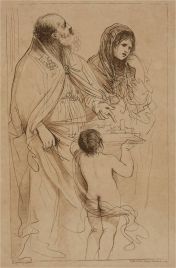
An etching after Giovanni Francesco Barbieri, best known as Guercino, depicting St Prosper showing the plan of a city from Volume 82 of 'Prints Engraved by F. Bartolozzi, etc, from the original drawings of Guercino, in the collection of His Majesty'. Inscribed with the names of the artists and dated in plate to the lower edge. On laid.
Condition
Cropped to the plate line at the left edge and just outside the plate lines at all other edges. There is some mild discolouration.
Size
20.3 x 13.3cm (8" x 5.2")Sheet: 22 x 16.3cm (8.7" x 6.4")
Francesco Bartolozzi RA (1727-1815) was an Italian engraver, whose most productive period was spent in London. He is noted for popularising the 'crayon' method of engraving. Bartolozzi was born in Florence in 1727. He was originally destined to follow the profession of his father, a gold- and silver-smith, but he manifested so much skill and taste in designing that he was placed under the supervision of two Florentine artists, including Ignazio Hugford and Giovanni Domenico Ferretti who instructed him in painting. After devoting three years to that art, he went to Venice and studied engraving. He spent six years there working for Joseph Wagner, an engraver and printseller, before setting up his own workshop. His first productions in Venice were plates in the style of Marco Ricci, Zuccarelli. He then moved for a short time in 1762 to Rome, where he completed a set of engravings representing frescoes at Grottaferrata by Domenichino depicting the life of St Nilus. Those and his etchings of Old Master's works, began to draw attention throughout Europe. In 1763 he met Richard Dalton, the English Royal Librarian who was traveling in Italy looking for acquisitions for the King's collections. Dalton offered him an appointment as Engraver to the King; Bartolozzi accepted and left for London in 1764.
He lived in London for nearly forty years. He produced an enormous number of engravings, including Clytie after Annibale Carracci, and of the Virgin and Child, after Carlo Dolci. A large proportion of them are from the works of Cipriani and Angelica Kauffman. Bartolozzi also contributed a number of plates to Boydell's Shakespeare Gallery. He also drew sketches of his own in red chalk. Soon after arriving in London, he was appointed 'Engraver to the King' (George III) with an annual salary of £300. He was elected a founding member of the Royal Academy. The new Academy's bylaws specifically excluded engravers but Bartolozzi was so well esteemed that he was brought in as an Academician in the category of Painter. In 1802 became the founding President of the short-lived Society of Engravers.
While Bartolozzi was not the original inventor of the crayon manner of engraving, he became a leading exponent that 'stipple' method and it became associated with him. With that technique images are created by delicate dots rather than lines as in traditional etchings or engravings. Bartolozzi added distinction to his work by using red (sanguine), orange and brown inks rather than common black ink.