The store will not work correctly when cookies are disabled.
We use cookies to make your experience better.To comply with the new e-Privacy directive, we need to ask for your consent to set the cookies. Learn more about our cookies policy.
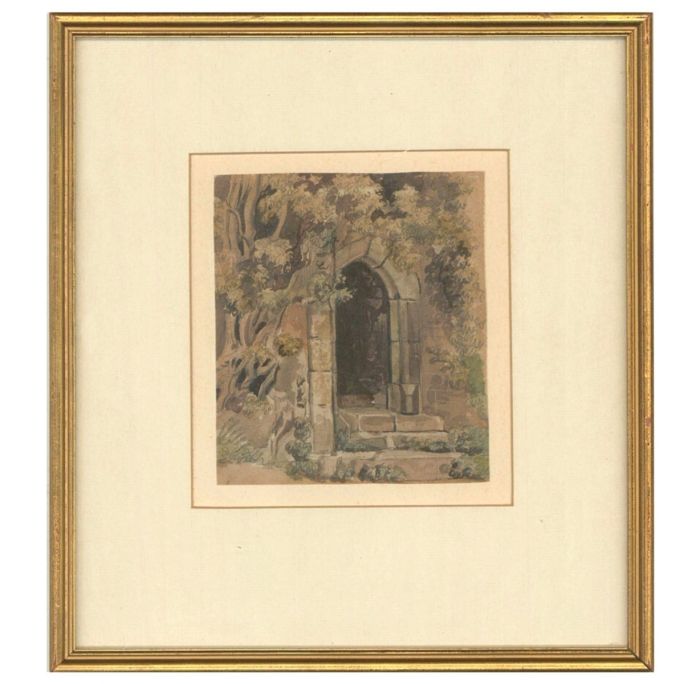
A view of an arched stone doorway at Raglan Castle, a late medieval castle located just north of the village of Raglan in Monmouthshire, Wales. Most famous as a painter of historical scenes, the castle would have interested the eighteen-year-old Ward as a romantic ruin that was besieged during the English Civil War. Presented glazed in a white mount and a distressed gilt-effect wooden frame. Initialled and dated 1834 beneath the mount. On watercolour paper.
Condition
There is some mild discolouration and some scuffs at the corners of the frame. Overall in good condition.
Size
11.8 x 10.6cm (4.6" x 4.2")Framed Size: 27.2 x 24.9cm (10.7" x 9.8")
Artist Biography
Edward Matthew Ward RA (1816-1879) was a British painter who specialised in historical genre. He is best known for his murals in the Palace of Westminster depicting episodes in British history from the English Civil War to the Glorious Revolution. Ward was born in Pimlico, London. As a youth, he created illustrations for the well-known book 'Rejected Addresses', written by his uncles James and Horace Smith. He also created illustrations to the papers of Washington Irving. In 1830 he won the 'silver palette' from the Society of Arts. With support from David Wilkie and Francis Leggatt Chantrey, he became a student at the Royal Academy Schools. In 1836 he traveled to Rome, gaining a silver medal from the Academy of St Luke in 1838 for his Cimabue and Giotto, which in the following year was exhibited at the Royal Academy.
While a student at the Schools, Ward became a member of The Clique, a group of painters led by Richard Dadd. Like other members of the Clique, Ward saw himself as a follower of Hogarth and Wilkie, considering their styles to be distinctly national in character. Many of his early paintings were set in the eighteenth century and were on Hogarthian subjects. He also painted episodes from seventeenth-century history, influenced by the thinking of his friend, the historian Thomas Babington Macaulay. He also painted subjects from the history of the French Revolution.
In the 1850s Ward came into conflict with the Pre-Raphaelites, especially Millais, whose style of art he considered to be un-British. Ward's painting of Charlotte Corday being led to execution beat Millais's 'Ophelia' for a prize at Liverpool, leading to much debate at the time.
Ward's historical paintings led to the commission to paint eight scenes in the corridor leading into the House of Commons, despite the fact that he had won nothing at the original 1843 competition. These were to depict parallel episodes on the Royalist and Parliamentary sides in the Civil War. Ward's paintings depict the opposed figures as if confronting one another across the corridor.