The store will not work correctly when cookies are disabled.
We use cookies to make your experience better.To comply with the new e-Privacy directive, we need to ask for your consent to set the cookies. Learn more about our cookies policy.
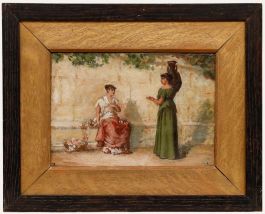
A scene featuring Diogenes, a Greek philosopher who made a virtue of poverty and begged for a living. He became notorious for his philosophical stunts, such as carrying a lamp during the day. Unsigned. On panel.
Condition
There are a couple of mild marks and scratches.
Size
31.3 x 37.5cm (12.3" x 14.8")Sheet: 35 x 40.4cm (13.8" x 15.9")
Collection Information
This collection of paintings by the set designer Bernard Robinson (1912-1970) offers a uniquely intimate perspective on the mind of the artist, as pensive portraits and warm and peaceful landscapes contrast with the lavish drama of his sets on horror and fantasy films. Further to this, Robinson was likely influenced by the English landscapes of artists such as John Nash CBE RA (1893-1977), capturing idyllic scenes that offered a counterpoint to the cultural and political turmoil of the 20th century. Predominantly consisting of sparsely peopled, bucolic, and peaceful works, this collection combines escapism with painterly skill.
Bernard Robinson (1912-1970) was a prominent Liverpool-born artist and set designer, best known for his mid-century films produced by Hammer, including 'The Curse of Frankenstein' (1957), 'Dracula' (1958), and 'The Phantom of the Opera' (1962).
Robinson spent the 1930s working for Warner Brothers at Teddington Studio as a draughtsman. After gaining promotion to art director, he joined Alexander Korda at London Films, working out of Denham Studios. His career was interrupted by wartime service and did not resume fully until 1956, when he joined Hammer Films as a production designer. Robinson soon acquired a reputation for creating a lavish look, given the limited budgets and cramped facilities at Hammer's Bray studio. He built sets that could be rapidly rebuilt to suit different requirements. In this manner, the crypt from 'Dracula' (1958) became the laboratory for 'The Revenge of Frankenstein' (1958). Similarly, the same Cornish village set doubled for both 'The Plague of the Zombies' (1966) and 'The Reptile' (1966). Castle Dracula itself was used again as Baskerville Hall for 'The Hound of the Baskervilles' (1959). Robinson's productive association with Hammer lasted until 1969. He died the following year.