The store will not work correctly when cookies are disabled.
We use cookies to make your experience better.To comply with the new e-Privacy directive, we need to ask for your consent to set the cookies. Learn more about our cookies policy.
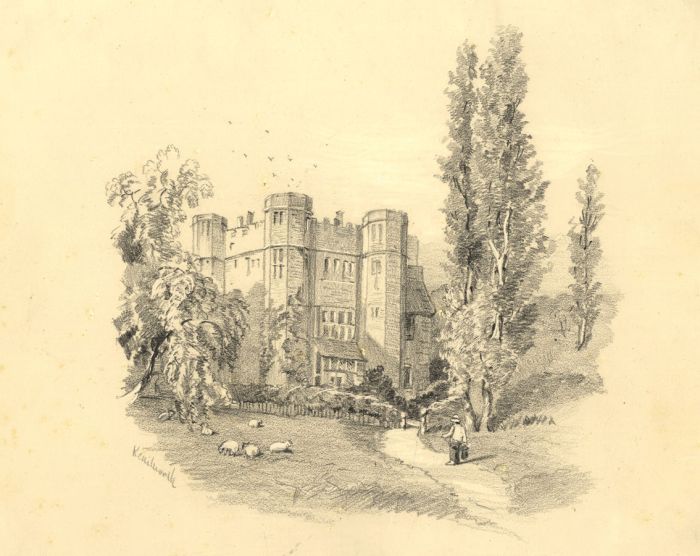
Attributed to William Gawin Herdman - Original Mid 19th Century Graphite Drawing. Attributed and titled on verso. Another illegible signature on verso. Inscribed verso. Some minor surface abrasions.William Gawin Herdman (1805–1882) was an English author and painter, known for his scenes in the Liverpool area of England. Herdman was a self-taught painter who started sketching in his early teens, documenting the city of Liverpool, making notes about how the city and its buildings were changing as the city grew. He painted around 2,000 watercolours of Liverpool scenes which were included in the book, Herdman’s Liverpool which appeared in several editions after his death in 1882. Herdman is best known as a landscape painter, typically of scenes around Liverpool. Herdman exhibited landscapes at the Royal Academy from 1834 to 1861. He joined the Liverpool Academy of Arts in 1836. In 1857 he left the Liverpool Academy over their annual award to Sir John Everett Millais for his 'The Blind Girl'. Herdman then established the rival Institution of Fine Arts. The local academies were run along similar lines to the Royal Academy, holding exhibitions of the work of local artists alongside that of leading artists of the day including John Landseer and his son Sir Edwin Henry Landseer, as well as Ford Madox Brown, William Holman Hunt and Millais. Because of conflicts within the Artist Community, both Academies closed by 1870. Herdman was a teacher and a successful commercial artist. He took commissions and after completing a series of paintings of scenes around Liverpool, which were also used to illustrate Herdman's books. 'The Pictorial Relics of Ancient Liverpool' contained 62 drawings on 49 plates, which he published in 1843 and 1856. Other publications include 'A Treatise of Curvilinear Perspectives' and its applications to Art published in 1854 and 'Thoughts on Speculative cosmology and the principles of Art' published in 1870.For more information please click here.