Description
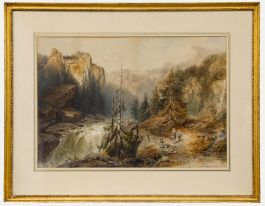
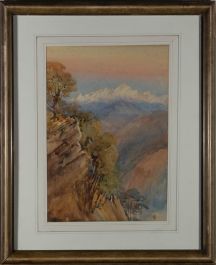
Artist name, date, and title inscribed to the wash line mount. Presented in a gilt frame with shell ornamentation. On paper.
Condition
The condition is typical for a picture of this age, including some discoloration and foxing. There are some minor losses to the frame.
Size
21 x 37cm (8.3" x 14.6")Framed Size: 43 x 53cm (16.9" x 20.9")
Artist Biography
James Baker Pyne was an English landscape painter who became a successful follower of Turner, after having been, in his earlier years, a member of the Bristol School of artists and a follower of Francis Danby. Pyne was born in Bristol, England, and taught himself to paint. His style and subject matter, namely the atmospheric depiction of local landscapes and imaginary scenes, were those of Danby and the Bristol School, among whom he was one of the most able oil painters. Examples include Imaginary Scene (1828) and View of the Avon from Durdham Down (1829).
In 1832, after producing some oil paintings of the Bristol Riots, he spent six weeks in France with his fellow Bristol School artist Edward Villiers Rippingille.
William James Müller had been apprenticed to Pyne during 1827–29/30. However, Müller did not remain much influenced by Pyne and the other Bristol School artists. Pyne himself did not long continue in the style of Danby's "poetical" landscapes. In the mid-1830s, probably in 1835, he moved to London, where he developed his mature style. His landscapes now followed Turner in their colors and style of composition. Turner's influence can be seen, for example, in Clifton, Near Bristol, from the Avon (1837), which was exhibited at the Royal Academy. Pyne exhibited at the British Institution during 1833–1844, at the Royal West of England Academy in Bristol, and at the Royal Academy during 1836–41. He became Vice-President of the Society of British Artists.
In 1846, he traveled to Germany, Switzerland, and Italy. He often painted in the Lake District. The art dealership Thomas Agnew and Sons commissioned him to paint in the Lake District in 1848, and then in 1851 to make a three-year tour of Italy, in which he was accompanied by the Bristol watercolourist William Evans. Pyne died on 29 July 1870 at his home, 203 Camden Road, London, leaving sons James Baker Pyne, a photographer, and Charles Pyne, an artist. He is buried with his wife Anne (1805-1865) on the western side of Highgate Cemetery. The grave (no. 13995) no longer has a headstone.