The store will not work correctly when cookies are disabled.
We use cookies to make your experience better.To comply with the new e-Privacy directive, we need to ask for your consent to set the cookies. Learn more about our cookies policy.
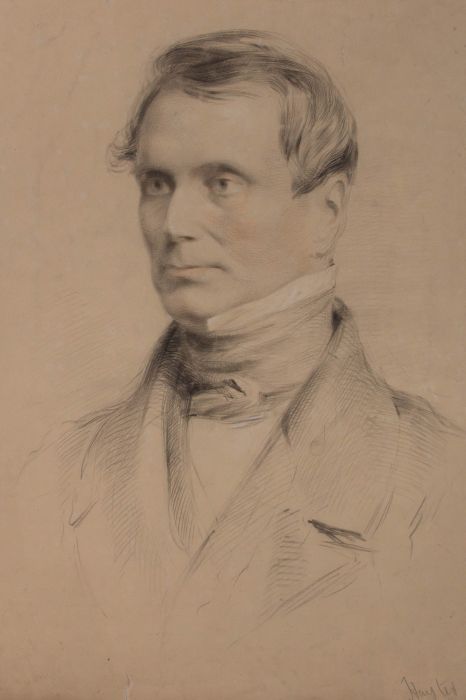
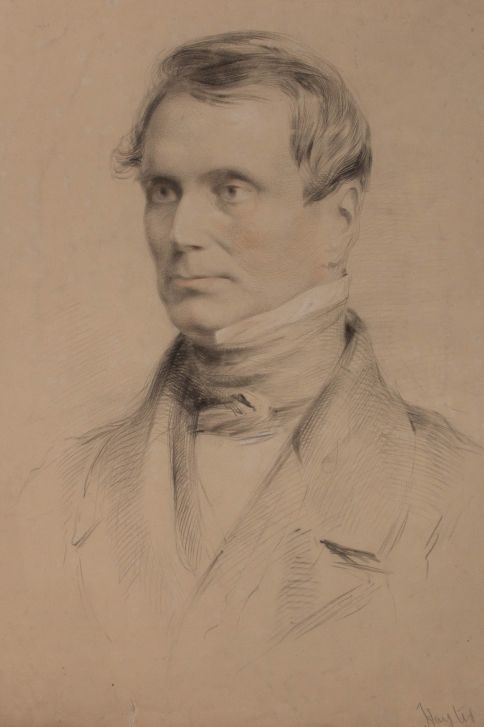
A portrait of a gentleman in charcoal and chalk. Signed 'Hayter' to the lower-right edge. Later indistinct inscription to the lower-left edge. On wove.
Condition
There is a closed tear measuring 3.6cm and a further small tear measuring 0.7cm to the lower edge. There are extensive creases and surface marks to the substrate. There is a small puncture repair to the upper-right quadrant.
Size
61 x 44cm (24" x 17.3")
Artist Biography
Sir George Hayter (11792-1871) was a notable English painter who specialised in portraits and large works which in some cases included several hundred individual portraits. Queen Victoria appreciated his merits and appointed Hayter her Principal Painter in Ordinary and also awarded him a Knighthood 1841. Hayter was the son of Charles Hayter (1761-1835) Initially tutored by his father, he went to the Royal Academy Schools early in 1808, but in the same year, after a disagreement about his art studies, ran away to sea as a Midshipman in the Royal Navy. His father secured his release, and they came to an agreement that Hayter should assist him while pursuing his own studies.
In 1809 he secretly married Sarah Milton, a lodger at his father's house, the arrangement remaining secret until around 1811. At the Royal Academy Schools he studied under Fuseli, and in 1815 was appointed Painter of Miniatures and Portraits by Princess Charlotte. Hayter was awarded the British Institution’s premium for history painting for the 'Prophet Ezra' (1815; Downton Castle), purchased by Richard Payne Knight. Around 1816 his wife left him, for reasons which are not apparent. He subsequently began a relationship with Louisa Cauty, daughter of Sir William Cauty, with whom he lived openly for the next decade and who bore him two children, Angelo and Louisa (despite not having sought a divorce from his first wife).
Encouraged by his patron, John Russell, 6th Duke of Bedford, he travelled to Italy to study in 1816. There he met Canova, whose studio he attended while painting his portrait, where he absorbed Canova's classical style. Returning to London in 1818, Hayter practised as a portrait painter in oils and history painter. Dubbed 'The Phoenix' by William Beckford, Hayter showed a pomposity that irritated his fellow artists, but he mixed freely with many aristocratic families. His unconventional domestic life (separated from his wife, yet living with his mistress) set him apart from official Academy circles: he was never elected to the Royal Academy.
In 1826 Hayter settled in Italy and he returned to England in 1831. His grandiose plan to paint the first sitting after the passage of the Reform Bill resulted in his painting 'Moving the Address to the Crown on the Opening of the First Reformed Parliament in the Old House of Commons, 5 February 1833' (1833-1843; London, NPG), for which he executed nearly 400 portrait studies in oil. He painted several royal ceremonies including Queen Victoria's coronation of 1838 and marriage of 1840 and also the Christening of the Prince of Wales of 1843 (all Brit. Royal Col.). He also painted several royal portraits including his most well-known work the State Portrait of the new Queen Victoria.