The store will not work correctly when cookies are disabled.
We use cookies to make your experience better.To comply with the new e-Privacy directive, we need to ask for your consent to set the cookies. Learn more about our cookies policy.
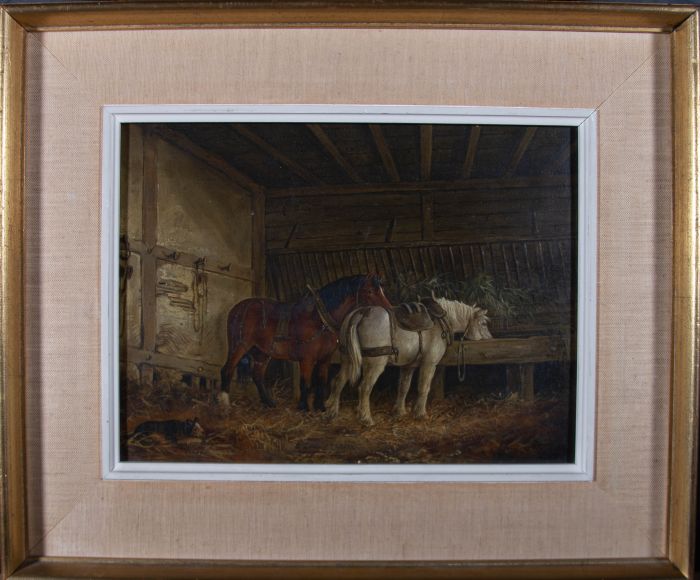
A rustic oil on wood panel, after the painter Benjamin Zobel (1762-1830). The scene shows two horses standing at a feeding trough in a darkened stable . A dog lies in straw in the lower left as soft daylight filters in through open stable doors, just out of sight. The artist has signed and dated to the lower edge after Zoble. The painting is presented in a contemporary gilt effect frame with a wide linen slip and white inner window. On wood panel.
Condition
The painting has a small paint loss to the lower left quadrant and general dirtying to the surface but is in otherwise fine condition. The frame is in fine condition.
Size
22 x 29cm (8.7" x 11.4")
Artist Biography
Benjamin Zobel (21 September 1762 - 24 October 1830) was a German-British painter, who developed the technique of sandpainting, also called marmotinto. Examples of these sandpaintings exist in the Memmingen city museum archives in Germany, the Victoria and Albert Museum in London, and Dundurn Castle in Hamilton, Ontario.
Zobel was born in Memmingen, Germany, at Weinmarkt 7, the family home and pastry business. Not only was Benjamin a gifted pastry chef, but he had also become an artist. Benjamin was asked to create table decorations (tray-painting or table-decking), using colored sugars on silver platters at the center of banquet tables at the royal court. These table decorations were popular at the time and involved creating various figures such as flowers, animals, or fruit. At the end of the meal, the colored sugars would be swept away. King George III suggested making longer lasting pictures and Benjamin Zobel developed a technique using colored sand fixed to wood or pasteboard using glue. Many of Benjamin Zobel's sandpaintings feature animals and country scenes similar to those seen in the paintings of his friend George Morland, a painter prominent in the "Isle of Wight School.” The Isle of Wight is well known for being a source of colored sands (Culture of the Isle of Wight). Zobel died in London.